The Psychology Of Selling: Why Investors Lose More From Behaviour Than Markets

Your portfolio is not your biggest risk. Your reaction to it might be.

Your portfolio is not your biggest risk. Your reaction to it might be.

Market downturns are not the exception. They are the price of admission for long-term growth.
Market crashes and rallies trigger emotional decisions. Smart investors stick to diversified ETF strategies, ignore short-term noise and stay invested for the long run.
Dollar-cost averaging (DCA) is one of the most widely used investment strategies in Canada. It reduces emotional decision-making and spreads entry risk—but does it actually outperform lump-sum investing? Here’s what the data and real-world behaviour suggest.
Tariffs and trade tensions can create short-term volatility—but for diversified, long-term investors, they rarely justify drastic portfolio changes. Here’s how to think about trade policy risk rationally.
Index investing has consistently delivered strong long-term results at low cost. Here’s why broad-market ETFs and all-in-one funds remain one of the most effective wealth-building strategies for Canadians.

Your portfolio’s asset allocation is the most important driver of its long-term performance. But markets drift—and without rebalancing, your risk exposure quietly shifts away from the plan you built. Here is how Canadian investors can rebalance strategically, without overtrading or reacting emotionally.

Market declines feel like emergencies. For long-term investors with a sound strategy and a diversified portfolio, they rarely are. Here is why staying invested through volatility—rather than stepping aside—is one of the most powerful wealth-building decisions a Canadian investor can make.
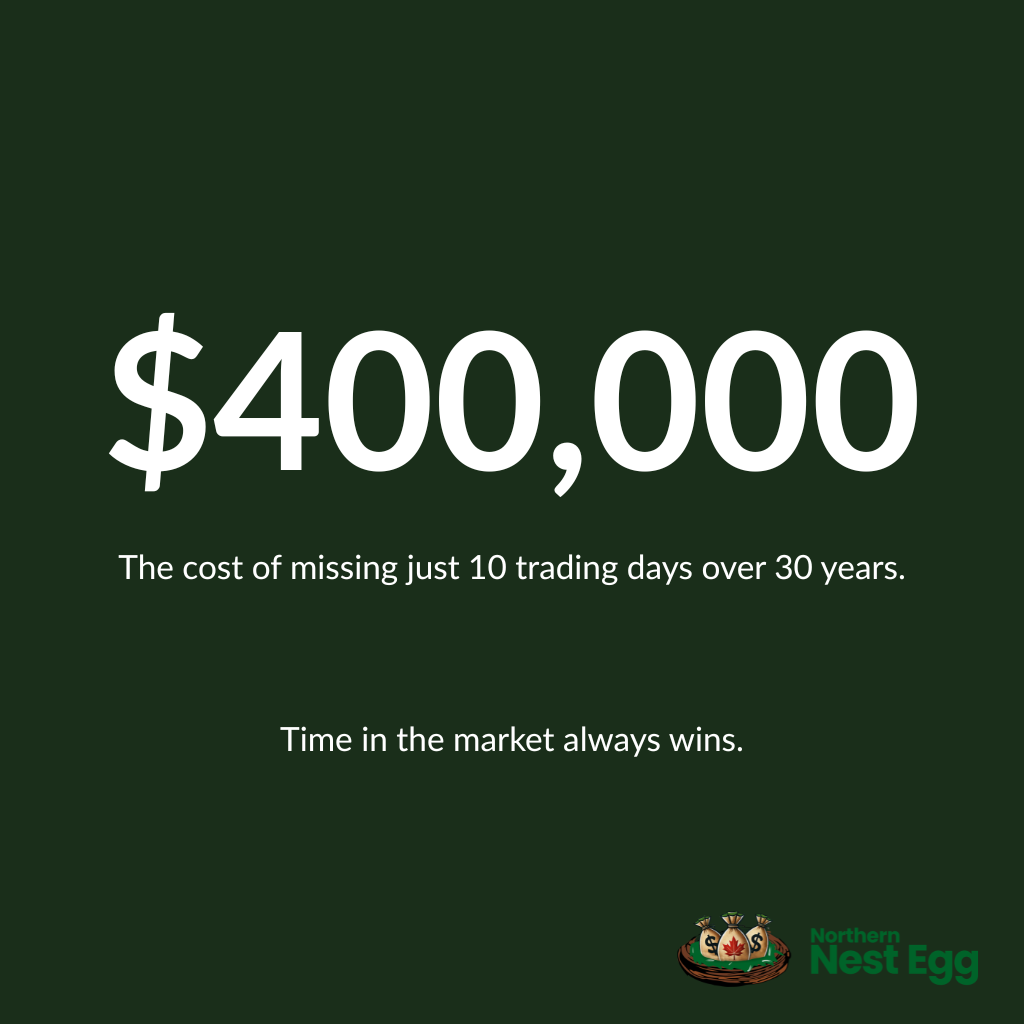
Trying to time the market requires getting two decisions right in sequence: when to exit and when to re-enter. Most investors get at least one wrong. Here is why staying invested in low-cost index ETFs consistently produces better long-term outcomes—and what the data actually shows.

Starting early gives young investors a powerful advantage. Here are five foundational principles to help Canadians build wealth, avoid costly mistakes and stay disciplined for the long term.